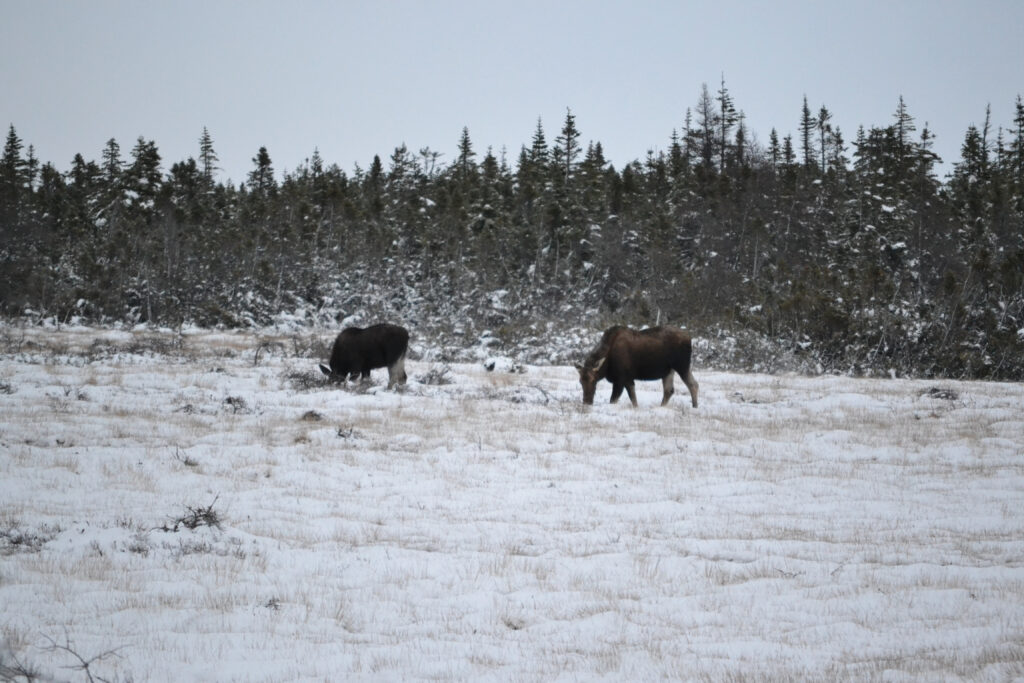
Winter in Newfoundland isn’t subtle. It’s snowy, it’s windy, it’s occasionally sideways, and it has absolutely no interest in your plans. But honestly… that’s part of the charm.
Because once the island puts on its winter coat, you’ve got two choices: stay inside watching the storm do its thing, or lean into it and make the most of it. Snowshoeing is the sweet spot—easy to learn, affordable compared to a lot of winter sports, and it turns “ugh, more snow” into “okay wait… this is actually unreal.”
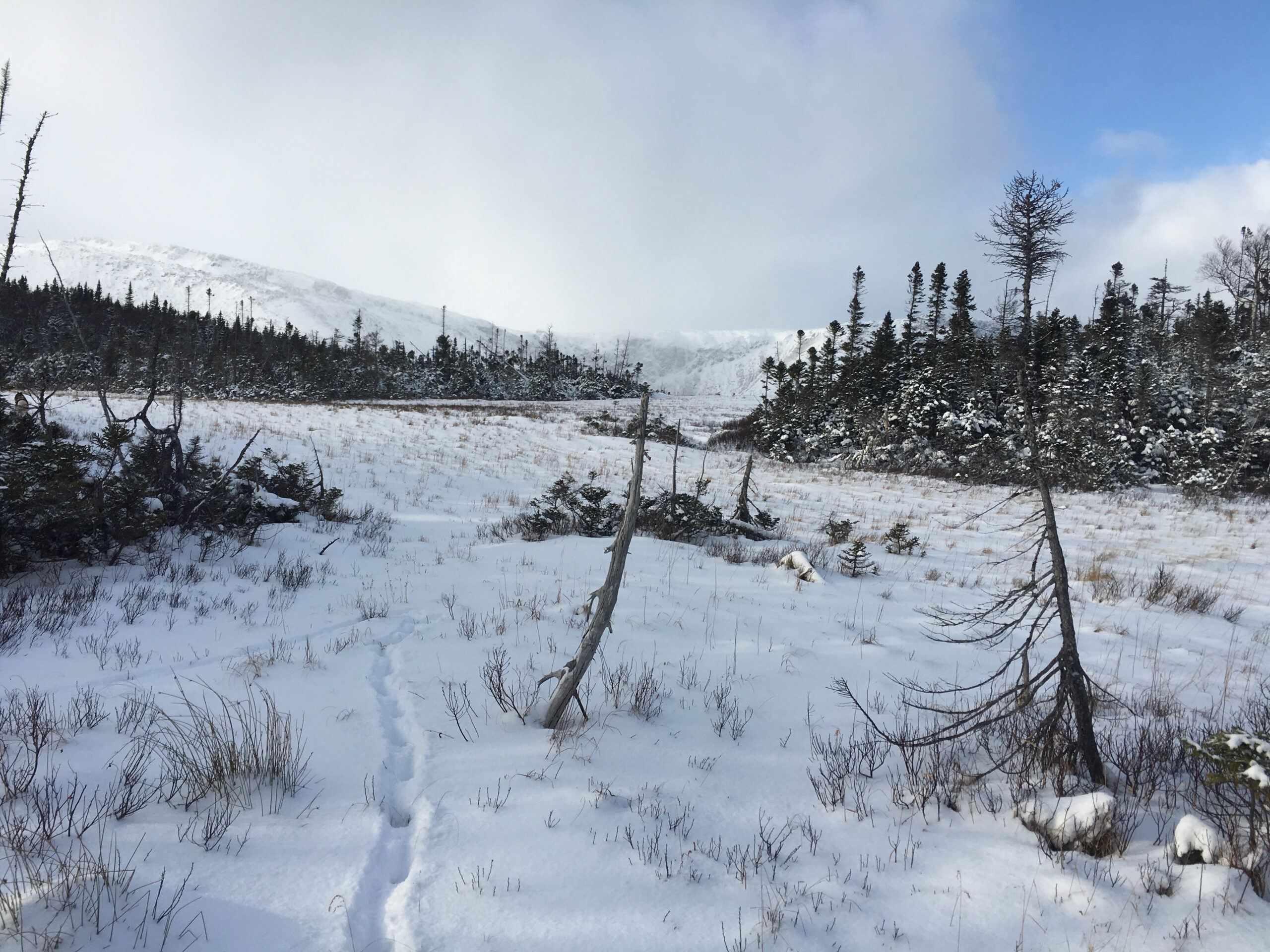
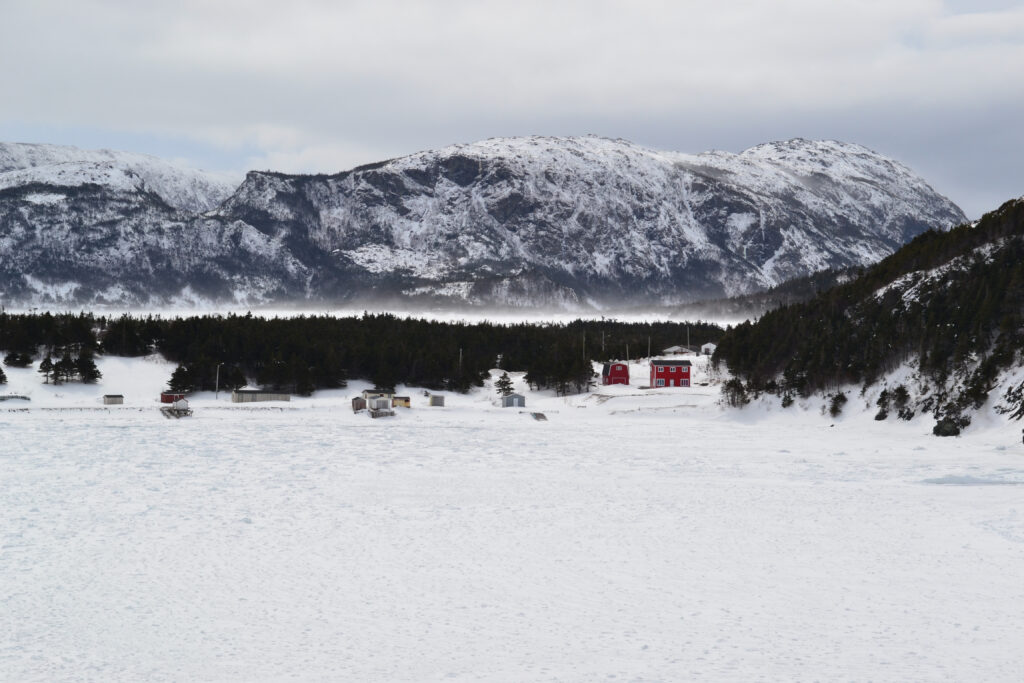
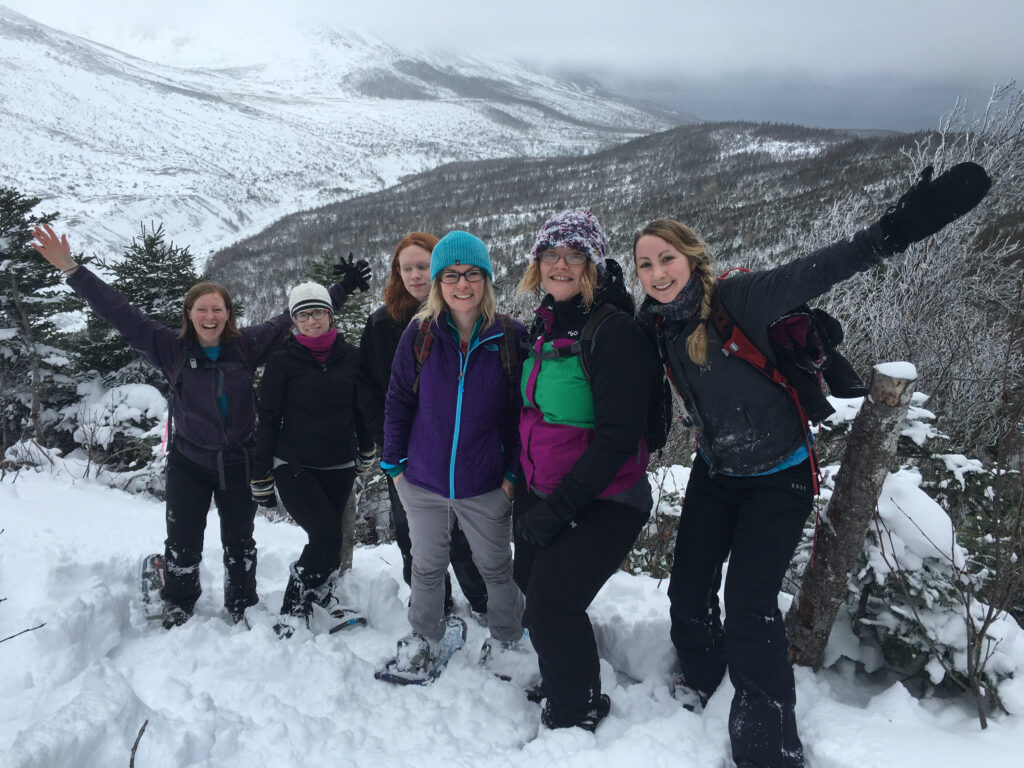
One day you’re crunching along a quiet trail in the woods with snow dusting the spruce boughs. The next, you’re climbing toward a viewpoint with the ocean foaming below you and the wind reminding you who’s boss. Either way, you’re getting fresh air, moving your body, and seeing Newfoundland at its most wild-and-beautiful… without needing to be a hardcore athlete to do it.
This guide is here to help you snowshoe Newfoundland like a local: what to expect from the weather, what gear actually matters, and the best trails to match your vibe—whether you’ve got kids in tow, you’re brand new to snowshoes, or you’re chasing big views and a proper winter workout.
Ads are how we keep our blog free for you to enjoy. We also use affiliate links; if you make a purchase through them, we may receive a small commission at no cost to you.
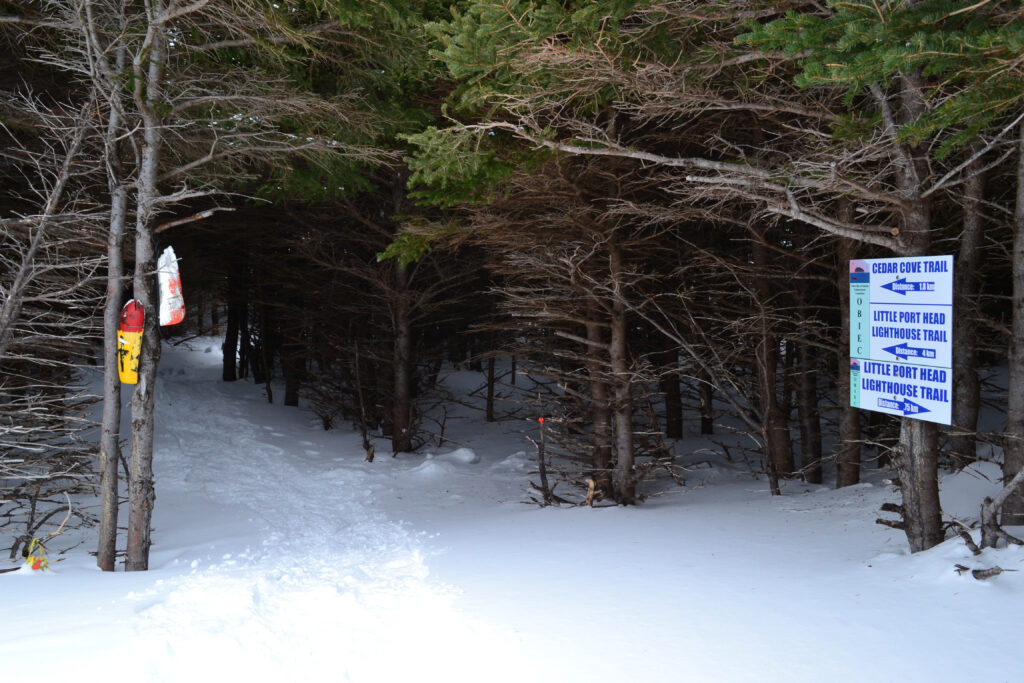
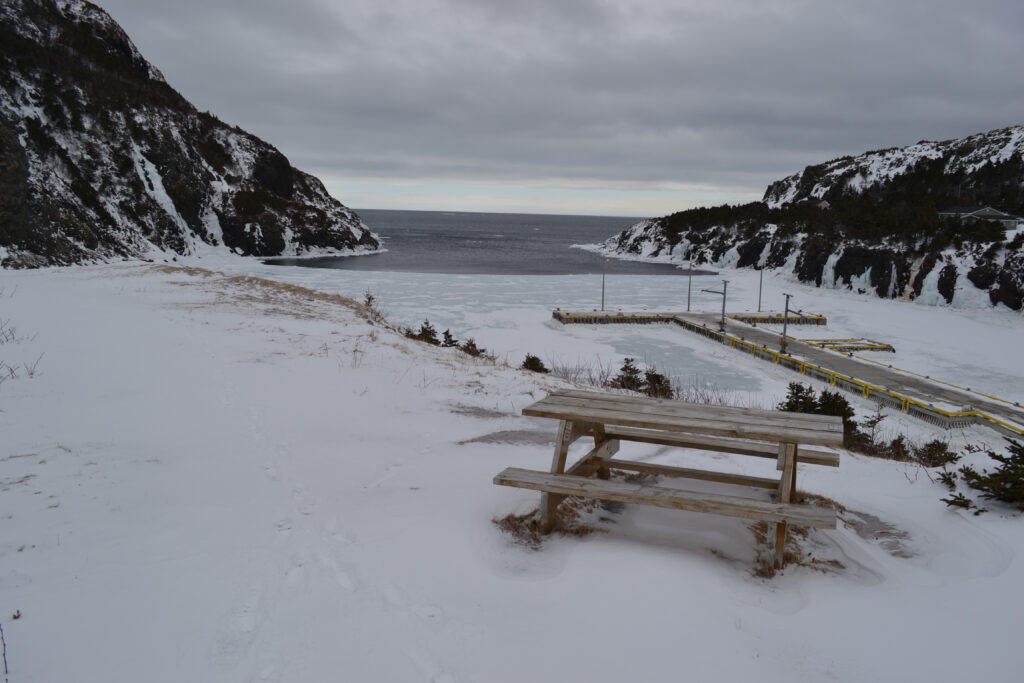
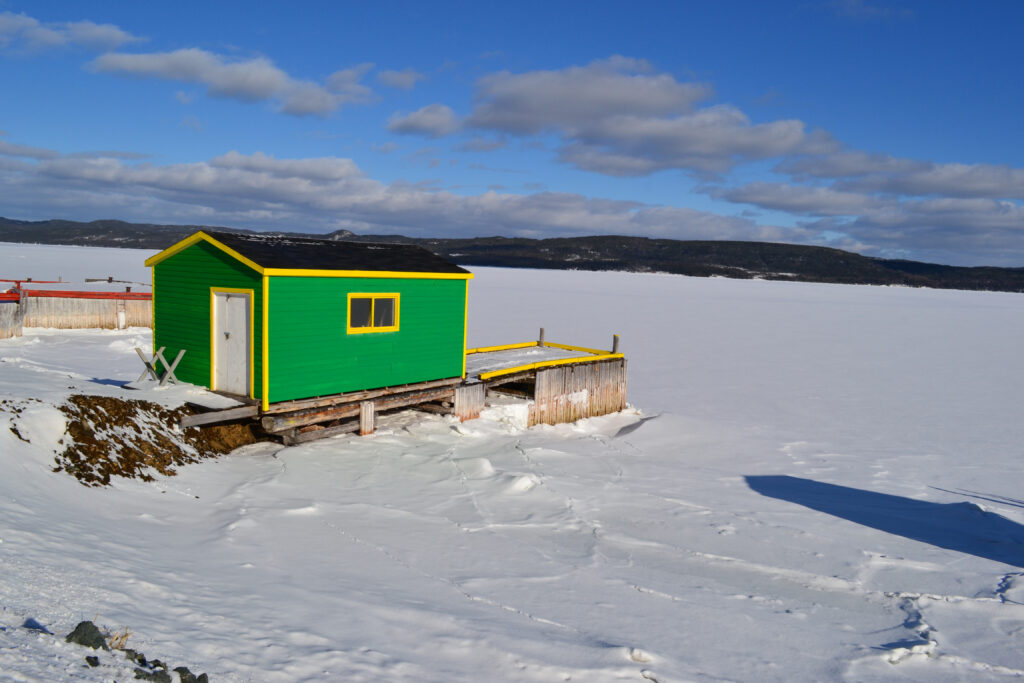
Why Snowshoe in Newfoundland
If you’ve ever looked out the window in January and thought, “Well… it’s winter again,” snowshoeing is your answer. It’s hands-down one of the best winter activities in Newfoundland because it turns all that snow (and the occasional icy surprise) into an actual reason to get outside—without needing fancy gear, a big budget, or expert skills.
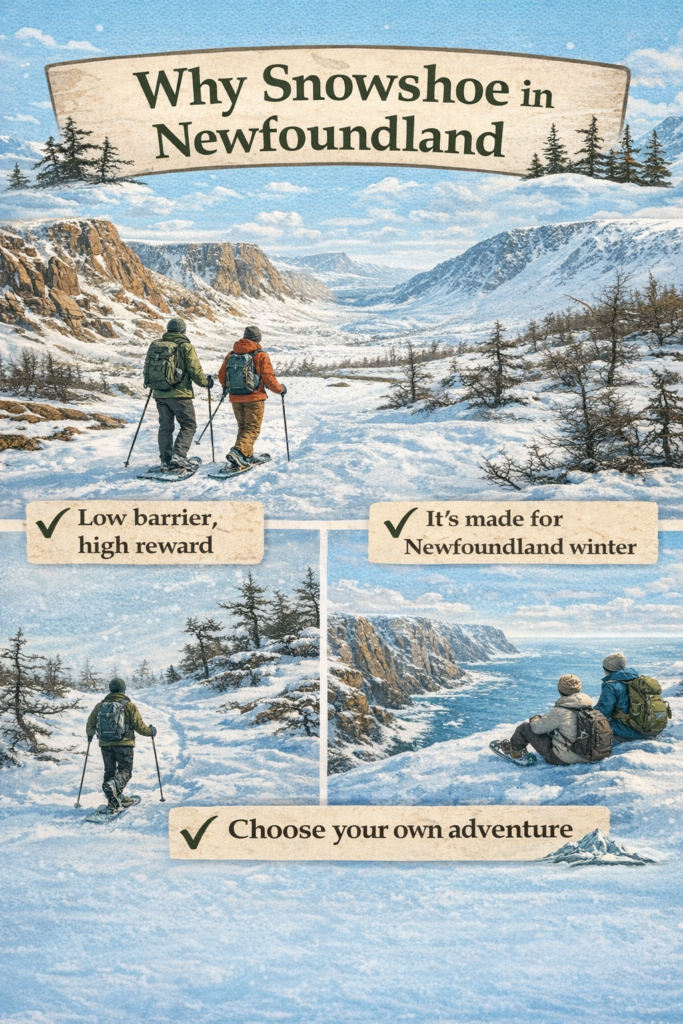
Here’s Why Locals Love It
- Low barrier, high reward. You don’t need lessons. You don’t need a resort pass. You can start on a flat, packed trail for a cozy little wander, and before you know it you’re chasing viewpoints and saying things like, “Just one more hill.” Snowshoeing is one of the most affordable ways to get into winter adventures, and it works for pretty much every age group and ability.
- It’s made for Newfoundland winter. Some days are too snowy for hiking, some days are too icy to feel confident in boots alone… but snowshoes don’t care. They give you grip, they keep you floating on softer snow, and they make winter trails feel doable again. Translation: you can still explore even when the island is being… the island.
- It’s a choose-your-own-adventure. Want a gentle stroll with kids and hot chocolate vibes after? Perfect. Want to climb something steep enough to make you question your choices (briefly) and then reward you with a ridiculous view? Also perfect. Snowshoeing meets you where you’re at—and lets you level up whenever you feel like it.
And if you’re here because you searched snowshoe trails Corner Brook, snowshoeing in St John’s Newfoundland, Humber River Valley snowshoeing, or simply Newfoundland winter —you’re in the right place. This guide is built like a local friend pointing you in the right direction: trails that match your fitness, the daylight you’ve got, and whatever mood the weather is in that day.
Newfoundland Winter Weather (what to expect — and how to plan for it)
Here’s the truth: Newfoundland winter weather is dramatic. Sometimes it’s the dreamy postcard version—fresh snow, blue sky, everything sparkling. Other times it’s an honest-to-goodness storm festival where the wind is trying to move you to a different postal code.
But don’t let that scare you off. It just means you plan smart.
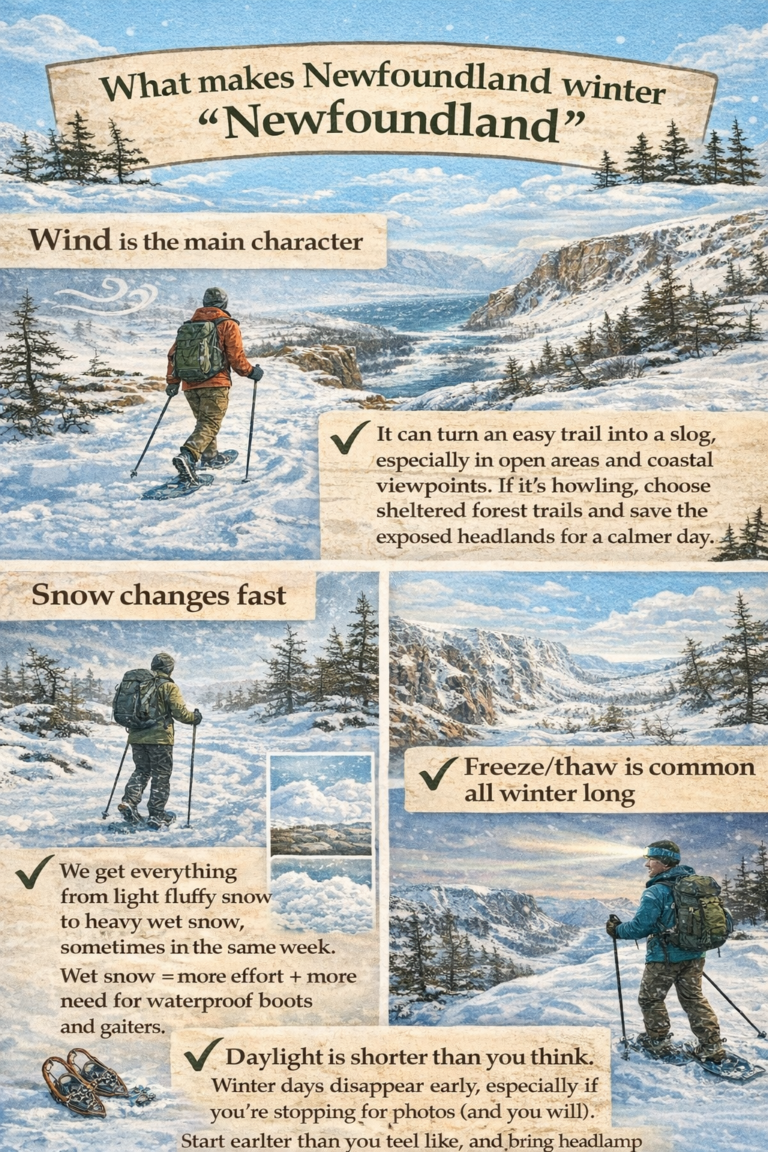
What makes Newfoundland winter Newfoundland
- Wind is the main character. It can turn an easy trail into a slog, especially in open areas and coastal viewpoints. If it’s howling, choose sheltered forest trails and save the exposed headlands for a calmer day.
- Snow changes fast. We get everything from light fluffy snow to heavy wet snow, sometimes in the same week. Wet snow = more effort + more need for waterproof boots and gaiters.
- Freeze/thaw is common all winter long. You’ll often see packed snow with icy patches. This is where snowshoes with good traction (and sometimes microspikes as backup) are a game-changer.
- Daylight is shorter than you think. Winter days disappear early, especially if you’re stopping for photos (and you will). Start earlier than you feel like, and bring a headlamp even on “short” trails.
Where to check the weather (and how to actually use it)
In Newfoundland, checking the weather isn’t a formality — it’s part of the adventure planning. The forecast can be “fine” in one town and full-on chaos 20 minutes down the road. So here’s how locals do it (quickly, and without overthinking it).
Local rule of thumb:
Forecast + a quick marine check + “what are people saying on the radio” = solid Newfoundland winter adventure planning.
1) Start with Environment Canada (your most reliable baseline)
This is my go-to because it’s clear, detailed, and updated often. Use this link:Environment Canada forecast (then search your nearest town)
How to read it like a trail person:
- Temperature: not just “high/low” — look at the trend by hour if you’re going out early or late.
- Wind: if you’re doing anything exposed (coastal trails, ridgelines), wind matters more than temperature.
- Wind chill: this tells you what it feels like — and it’ll change what layers you bring.
- Precipitation: “snow” is fine; “snow + wind” can mean low visibility and drifting (and bring goggles!)
Quick decision tip:
If the wind is high or gusty, pick a sheltered forest trail instead of a headland viewpoint route.
2) If you’re going coastal, check the marine forecast too
This is the secret weapon for understanding what’s happening on the coastlines — and Newfoundland weather is basically… in a relationship with the ocean. Use this link: Environment Canada Marine Forecast (Newfoundland & Labrador)
How to use it:
- Find the marine zone closest to where you’ll be snowshoeing (west coast, Avalon, etc.).
- Look for wind speed, wind warnings, and wave conditions/freezing spray (yes, waves matter — they’re a clue for how rough and gusty it’ll feel on coastal trails).
- If you see strong winds or warnings, it’s a good day for inland routes (valleys, woods, groomed networks).
3) Bonus: local radio is weirdly excellent for real-life conditions
Local stations are often the quickest way to get the practical stuff you actually care about:
- current temps (not just what it “should be”)
- snowfall totals
- wind speed + wind chill
- road / visibility updates during storms (so you can actually get to the trailhead!)
If you’re on the fence, listen for 2 minutes while you’re putting on your boots — it can save you from choosing the wrong trail for the day.
A local-style decision-making checklist (aka: don’t fight the island)
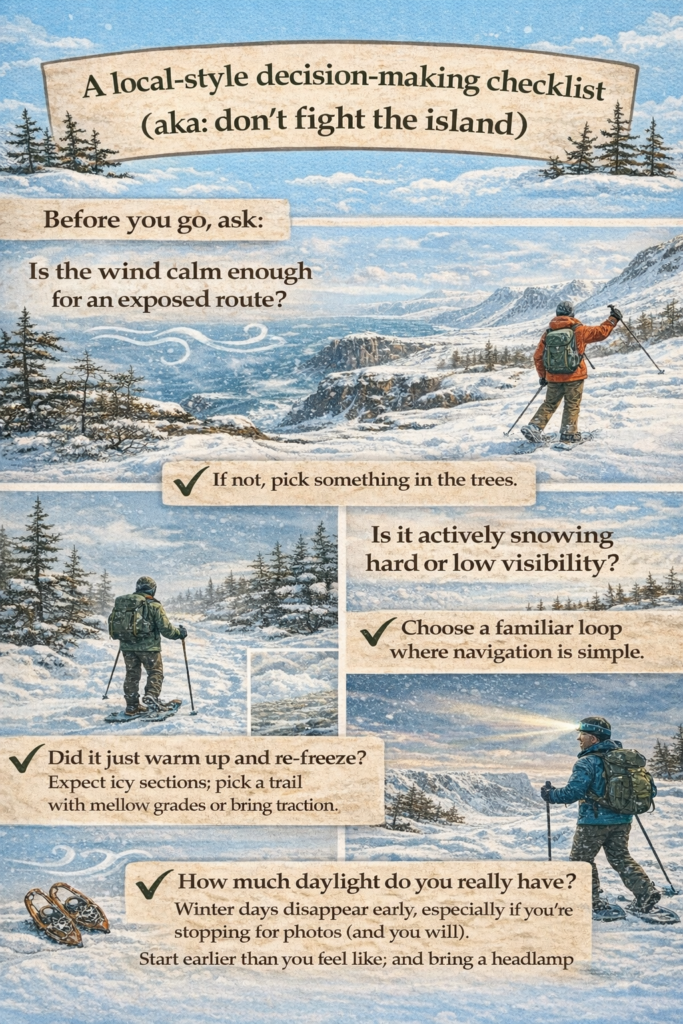
Before you go, ask:
- Is the wind calm enough for an exposed route? If not, pick something in the trees.
- Is it actively snowing hard or low visibility? Choose a familiar loop where navigation is simple.
- Did it just warm up and re-freeze? Expect icy sections; pick a trail with mellow grades or bring traction.
- How much daylight do you really have? Give yourself a turnaround time and stick to it.
The best part (and why we still go)
Even on a stormy week, there’s almost always a window—an afternoon break, a calm morning, a fresh snowfall that turns everything quiet. Snowshoeing makes winter feel like something you get to do, not something you have to “get through.”
And honestly… Newfoundland’s going to snow either way. Might as well go play in it.
What Snowshoes are Best (and how to choose)
There isn’t one “best” snowshoe—there’s the best snowshoe for your terrain. Below is a quick summary however, if you’re considering buying, read my How to Choose Snowshoes: A Beginner’s Guide.
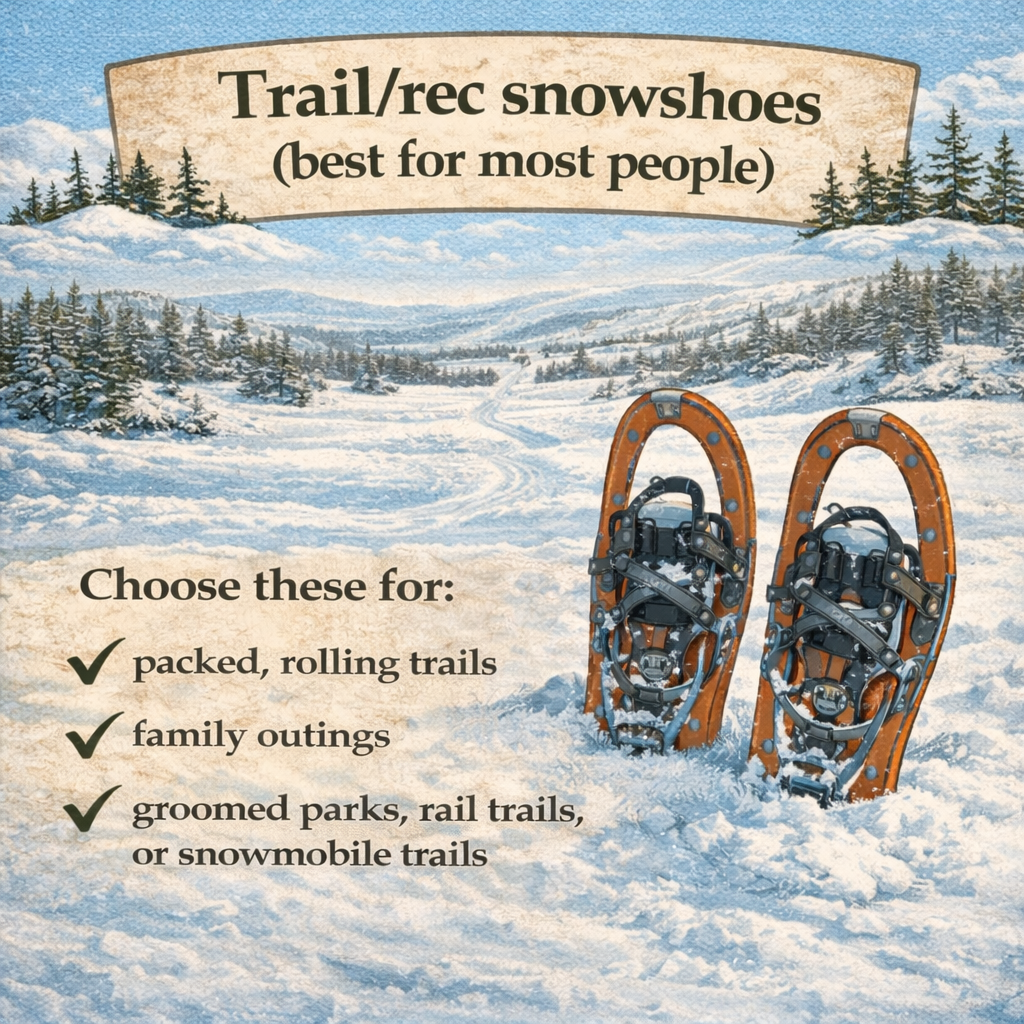
1) Trail/Rec Snowshoes
(best for most people)
Choose these for:
- packed, rolling trails
- family outings
- groomed parks, rail trails, or snowmobile trails
Look for: comfortable binding, decent traction, and a size matched to your total weight (body weight + pack weight).
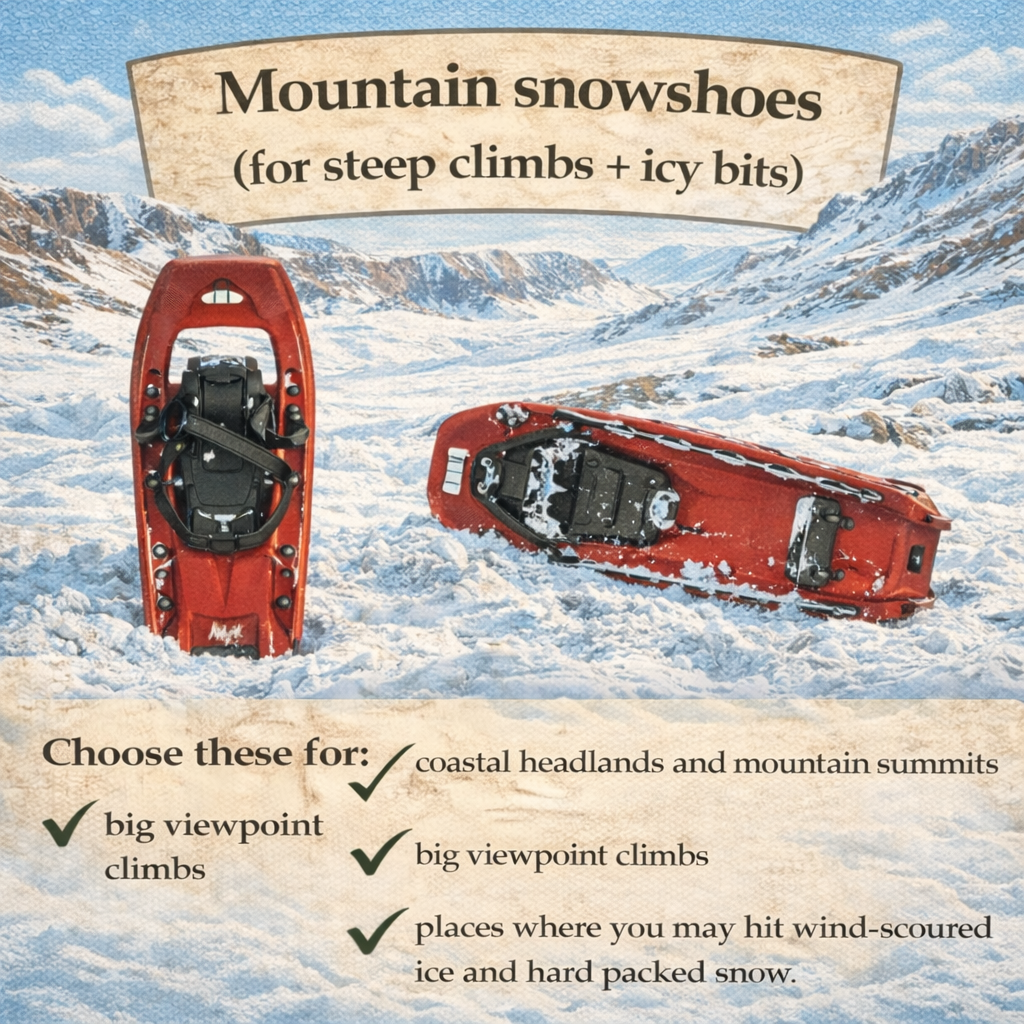
2) Mountain Snowshoes
(for steep climbs + icy bits)
Choose these for:
- coastal headlands and mountain summits
- big viewpoint climbs
- places where you may hit wind-scoured ice and hard packed snow
Look for: aggressive crampons, including steel traction rails, and heel lifts (they save your calves on long climbs). I 🩵 MY MSR EVO’s!
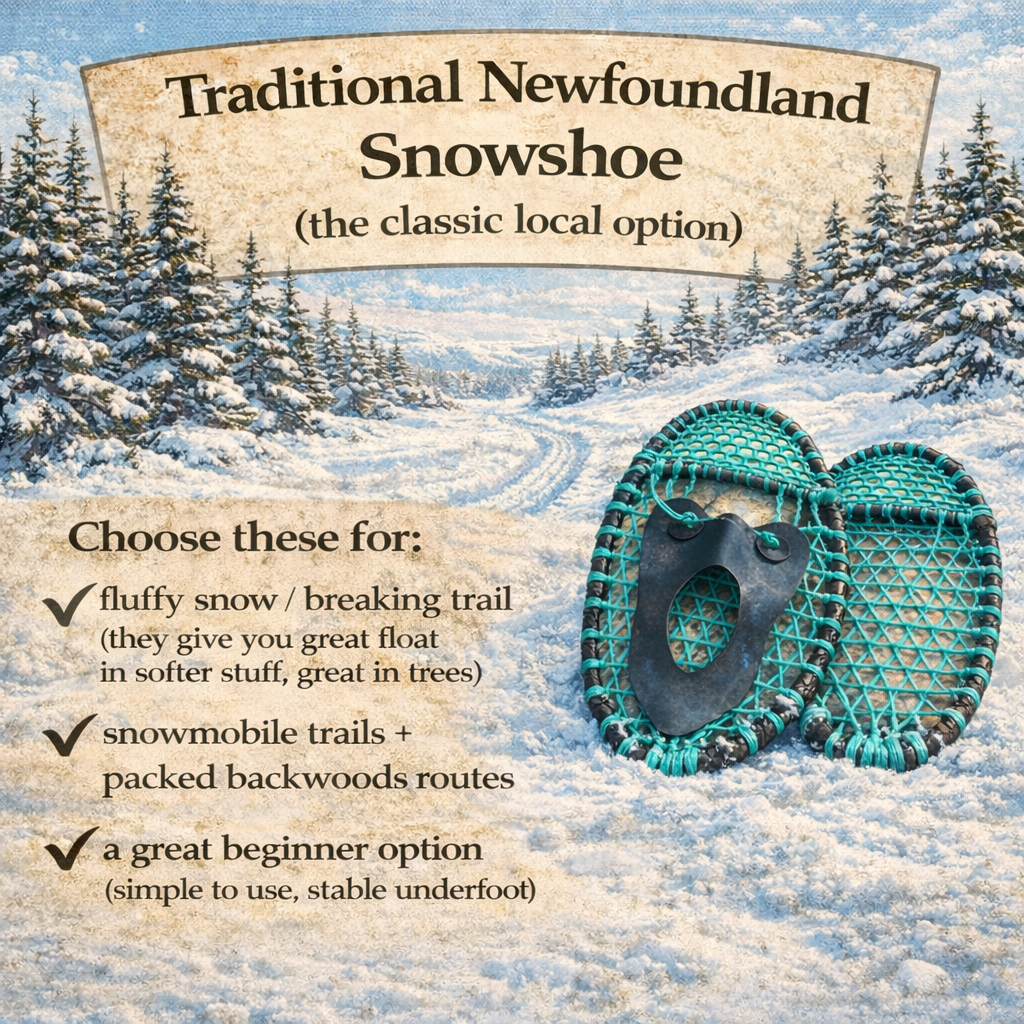
3) Traditional Newfoundland Snowshoe
(the classic local option)
Choose these for:
- fluffy snow / breaking trail (they give you great float in softer stuff, great in trees)
- snowmobile trails + packed backwoods routes
- a great beginner option (simple to use, stable underfoot)
Look for: teardrop shape (short + wide), a sturdy frame (steel or aluminum) + tight lacing/webbing (no big saggy gaps)
Snowshoe Rentals in Newfoundland
Alright — if you don’t own snowshoes yet, renting is the move. Newfoundland winters can be stormy, snowy, and downright chaotic… so you might as well lean in and go play outside, right? The good news: lots of parks, ski clubs, and local operators have rentals, and some even bundle them with trail passes.
Quick rental tips (so your day actually goes smoothly)
- Call ahead on weekends: popular spots can run out of sizes fast.
- Ask if poles are included (they make a huge difference on hills + icy bits).
- Dress for “start cold, finish warm”: layers + a wind shell = happy you.
- If you’re going with kids: choose groomed networks (easier footing, easier turn-around points).
Where to Rent Snowshoes
Western Newfoundland
- Blow Me Down Cross Country Ski Club (Corner Brook)
One of the best one-stop winter playgrounds: groomed trails + dedicated snowshoe routes + rentals right on-site. Snowshoe rentals: Adult $20 / Child $12.50 (plus taxes where applicable).
Learn more: Rates & Rentals - Pasadena Ski and Nature Park (Pasadena)
A super friendly place to start (and a great “bring the family” spot). They offer snowshoe passes and rentals—just call for details. Phone: 709-686-5515.
Learn more: Rates & Rentals - Whaleback Nordic Ski Club (Stephenville)
Great trail system with day passes + rentals available. Their published rates note snowshoes are free to rent (nice!), and the Town of Stephenville lists rentals + passes and shares their phone number (709-643-3841).
Learn more: Rates & Rentals and Stephenville Winter Activities - Wild Gros Morne
A very “show up and enjoy winter” option. Their rentals are available Oct 1– May 1 each year. Call or email for availability: Phone +1 709-660-9453, Email [email protected]. They also note guided options are available.
Learn more: Snowshoe Tours & Rentals
Central Newfoundland
- Airport Nordic Ski Club (Gander)
If you want a “pay your day fee and go” setup, this is a great one. Their site breaks down snowshoe day fees and rental rates, and notes that rentals can be included depending on what you’re doing.
Learn more: Pass and Rental Fees
Eastern Newfoundland & St. John’s area
- City of St. John’s Winter Activity Centre (Pippy Park / North Bank Lodge)
This is one of the easiest places to rent if you’re in the city: $5/hour per person, family hourly rates available, and clear rental hours posted (weather-dependent, because Newfoundland).
Learn more: Winter Activity Centre open + rental details - Mount Pearl (Free gear lending program)
Mount Pearl has run a free ski + snowshoe borrowing program (limited quantities), which is amazing for trying it out before you spend money. Check the City’s posts for dates and weekly details.
Learn more: Program announcement post - Whale House Guest House (Mobile / East Coast Trail area)
A fun little bonus option: they’ve mentioned free snowshoe rentals near the trail access in Mobile. (I’d still message ahead—small places = limited inventory.)
Learn more: Winter adventures post
Guided Snowshoe Tours
If you’d rather not think too hard about route-finding, conditions, or packing the perfect layers, these are solid plug-and-play choices:
- Guided snowshoe or ski tour (Gros Morne) — day tour style, includes equipment + instruction.
Snowshoe and Ski Tours in Gros Morne - Guided snowshoe + campfire boil-up (Gros Morne) — classic Newfoundland vibes: move your body, then warm up properly.
Snowshoe Tour & Campfire Boil Up - Multi-day snowshoe retreat (Gros Morne) — a winter getaway with meals + guiding built in.
Snowshoe Retreat in Gros Morne
Where to Snowshoe in Newfoundland by Region
How these trail stats work: Distances and elevation gain below come from the linked trail sources (often GPS-based). Always confirm route options + current conditions before you go.
You can also browse snowshoe-specific listings here: AllTrails snowshoeing in Newfoundland & Labrador.
Western Newfoundland
Bay of Islands & Humber Valley
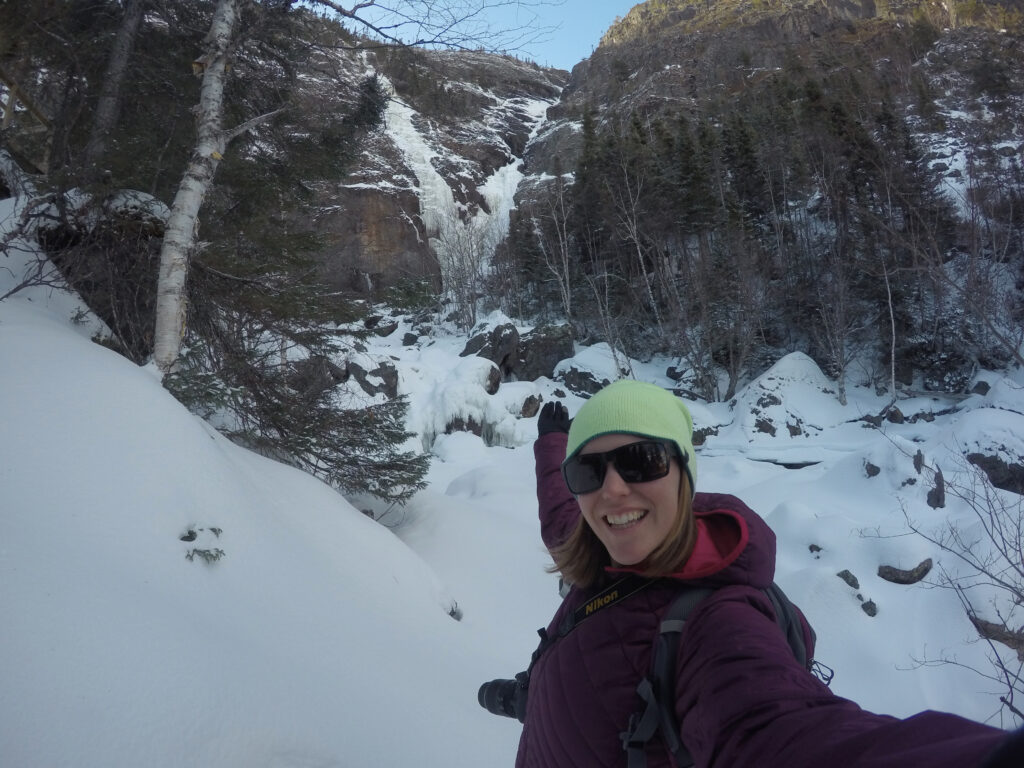
This is prime territory for Humber River Valley snowshoeing and local classics near Corner Brook.
Easy
- Bottle Cove Trail — Quick coastal views and an easy confidence-builder. 1.6 km, 45 m gain.
- Cedar Cove Trail — A little longer, still friendly. 2.7 km, 85 m gain.
- Ginger Route Trail — Great local loop inside Corner Brook city limits. 4.0 km, 95 m gain.
- Tipping’s Pond Trail — Classic easy loop for a mellow outing. 2.6 km, 65 m gain.
- Humber River Trail — Flat-ish and cruisy when conditions are right. 8.0 km, 30 m gain.
Moderate
- Corner Brook Stream Trail via Pipeline Trail — A step up in distance and effort; great winter pace. 5.1 km, 100 m gain.
- Hummock Trail — A satisfying outing with steady work. 6.8 km, 205 m gain.
Hard
- Southhead Lighthouse Trail — Short, punchy, and rewarding. 2.3 km, 85 m gain.
- Copper Mine to Cape Trail — Big climb energy and unreal viewpoints. 6.8 km, 340 m gain.
- Man in the Mountain Trail — One of the best “earn your view” local missions. 9.7 km, 285 m gain.
Gros Morne
Snowshoeing here is next-level scenic. Start with Parks Canada’s guidance first: Snowshoeing in Gros Morne.
Easy
- Coastal Trail (Green Point) — Beautiful ocean edge trail that’s approachable in good conditions. 6.0 km, 33 m gain.
- Tablelands Trail — Snowshoe the Earth’s mantle with wide open views. It’s an easy win even on short winter days. 4 km return, 88 m gain.
- Western Brook Pond — one of the most iconic views in Gros Morne, and the trail is super approachable for a winter outing. 6 km return, 42 m gain.
Moderate
- Lookout Trail — One of the best “short-ish but scenic” options. 6.3 km, 270 m gain.
- Baker’s Brook Falls — Waterfall + wildlife enclosure combo. 8.9 km, 150 m gain.
Hard
- Base of Gros Morne Mountain — Serious winter outing even without summiting. 9.0 km, 365 m gain.
Looking for the Best Trails to Hike in Gros Morne in Summer?
Snowshoe season is magic… but if you’re planning a warm-weather trip, Gros Morne absolutely shines in summer. Think epic viewpoints, coastal walks, waterfalls, and those classic “wow, this place is unreal” hikes.
👉 Best Hikes in Gros Morne National Park (Summer Trail Guide)
Northern Peninsula
Easy
- Norstead Trail — Short, beginner-friendly, great quick outing. 1.0 km, 10 m gain.
- Birchy Nuddick Trail — A tidy loop with just enough elevation to feel fun. 1.3 km, 30 m gain.
Moderate
- Fishing Point Park Trails — Great views for the effort. 2.6 km, 110 m gain.
- Cape Norman Trail — Windy, dramatic coastline; pick a clear day. 7.4 km, 245 m gain.
Hard
- Goose Cape Trail — A real leg-burner with big scenery. 11.1 km, 335 m gain.
- Cape St. Anthony Trail — Long, steep, exposed in spots—plan well. 8.9 km, 325 m gain.
Central Newfoundland
Easy
- Cobb’s Pond Trail — A dependable, low-stress option. 4.8 km, 20 m gain.
- Corduroy Brook Nature Trail — Short loop with a bit of variety. 2.7 km, 65 m gain.
Moderate
- Ochre Hill Trail — Forest + views; great “half-day” feel. 6.8 km, 155 m gain.
- Goowiddy Path — Longer and more committing. 7.6 km, 220 m gain.
Hard
- Malady Head Trail — Short distance, big climb. 3.9 km, 235 m gain.
- Outport Trail — Very long, serious undertaking (consider shorter sections). 33.2 km, 1040 m gain.
Eastern Newfoundland & St. John’s
Great options for St. John’s-area snowshoeing (and beyond).
Easy
- Manuels River Trailway — Family-friendly and straightforward. 2.7 km, 25 m gain.
- Quidi Vidi Lake Trail — Classic city loop for a quick winter reset. 4.7 km, 45 m gain.
Moderate
- Pippy Park Trail — In-town, hilly, great workout. 4.5 km, 200 m gain.
- La Manche Village Path — Suspension bridge + forest vibes; magical in fresh snow. 5.5 km, 195 m gain.
Hard
- Sugarloaf Path — Big climb, big payoff (weather dependent). 13.0 km, 520 m gain.
- Spout Path and Heretic Hill — One of the hardest local outings; only in solid conditions. 23.0 km, 1105 m gain.
- Maddox Cove to Cape Spear — Long coastal route; plan transport for point-to-point. 11.6 km (one-way), ~210 m gain.
Bonus: East Coast “destination” classics (outside St. John’s)
- Skerwink Trail — Sea stacks, cliffs, and constant views. 5.1 km, 60 m gain.
- Fox Island Trail — A favourite with a solid climb for the distance. 7.1 km, 150 m gain.
Safety + comfort checklist
Gear that makes snowshoeing better:
- Waterproof boots + gaiters (wet snow is real)
- Poles with snowbaskets (especially on uneven or icy terrain)
- Baselayer + Puffy + shell + warm hat (layers beat one big coat)
- Headlamp (daylight disappears fast)
- Offline map (or a downloaded map) + a “turnaround time”
Trail etiquette:
- If a trail is groomed for skiing, avoid stepping in the ski tracks.
- Stay on the packed line where possible to reduce making extra trails that cause confusion for other snowshoers.
- Please pee well away from the trail and also – if your dog poops, pick up or throw it off the trail!
Get the ONLY trail guidebook for the Island!
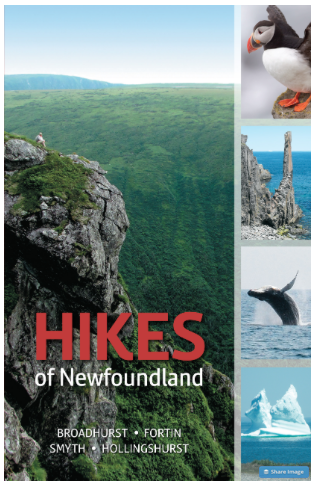
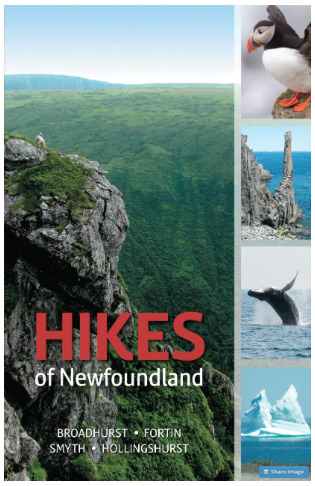
A local trail cheat code: Hikes of Newfoundland
(my guidebook)
If you’re the kind of person who stands at the door in winter gear thinking, “Okay… where are we going that won’t turn into a whole thing?” — this is exactly why I made Hikes of Newfoundland.
It’s your year-after-year, grab-and-go trail guide for allows you to quickly pick something that fits:
- the weather mood (calm and sunny vs. sideways snow)
- your energy level (easy loop vs. “let’s earn the view”)
- the time you actually have (hello, short winter daylight)
- who’s coming with you (kids, friends, new snowshoers, the family from the flatland)
Instead of doom-scrolling maps and second-guessing trail choices, you can flip to a hike, see what you’re in for, and get out the door.
Get Offline Maps for Snowshoeing
Find the perfect map for every kind of adventure with Gaia GPS. Get 10% off a new Gaia GPS Premium or Outside+ membership and go explore with 300+ maps and offline navigation.
FAQ
When is the best time to snowshoe in Newfoundland?
Usually once there’s a stable snowpack (often mid-January to end of March), but timing varies by region and weather cycles.
Is snowshoeing in St. John’s Newfoundland worth it?
Yes—city-adjacent trails like Pippy Park and Quidi Vidi make it easy to get out even on short winter days.
Where can I find snowshoe trails in Corner Brook?
Corner Brook has multiple strong options (like the Ginger Route and Man in the Mountain).
Go Play in Winter (Newfoundland Style)
So that’s the thing about snowshoeing in Newfoundland: winter doesn’t have to be something you endure. It can be something you actually look forward to.
Because once you’ve got snowshoes on your feet, the island opens up in a whole new way—quiet woods, fresh snow underfoot, coastal viewpoints that feel extra dramatic in winter, and those perfect little “storm break” afternoons where the sky goes blue and everything sparkles like it’s showing off.
Start small. Pick an easy loop, bring a snack (and maybe a thermos), and let it be a “get outside” kind of day—not a suffer-fest. Then, when you’re ready, chase a viewpoint, try a longer route, or make it a weekend and head for Gros Morne. Newfoundland will happily meet you wherever you’re at.
And if you’re ever standing at the door thinking, “Okay… where should we go today?” — check the forecast, choose a trail that matches the wind and daylight, and get out there. The snow is going to fall either way. Might as well enjoy it.
Before you go:
- Double-check the forecast (and the marine forecast if you’re going coastal)
- Pack layers + a headlamp
- Pick a trail that fits the day
- And go make winter feel like a child’s adventure again
Recommended Reads
Ultimate Guide to Hiking Gros Morne Mountain Trail (James Callaghan Trail)
Gros Morne Mountain is the iconic summit hike in Gros Morne National Park, Newfoundland—a full-day, legs-on-fire kind of climb that rewards you with a rare arctic-alpine plateau and sweeping views over Ten Mile Pond and the Long Range Mountains. This guide covers the full route (Approach + Summit loop), spring closure dates, seasonal conditions, weather…
Snowshoe Adventure: Gravels Walking Trails
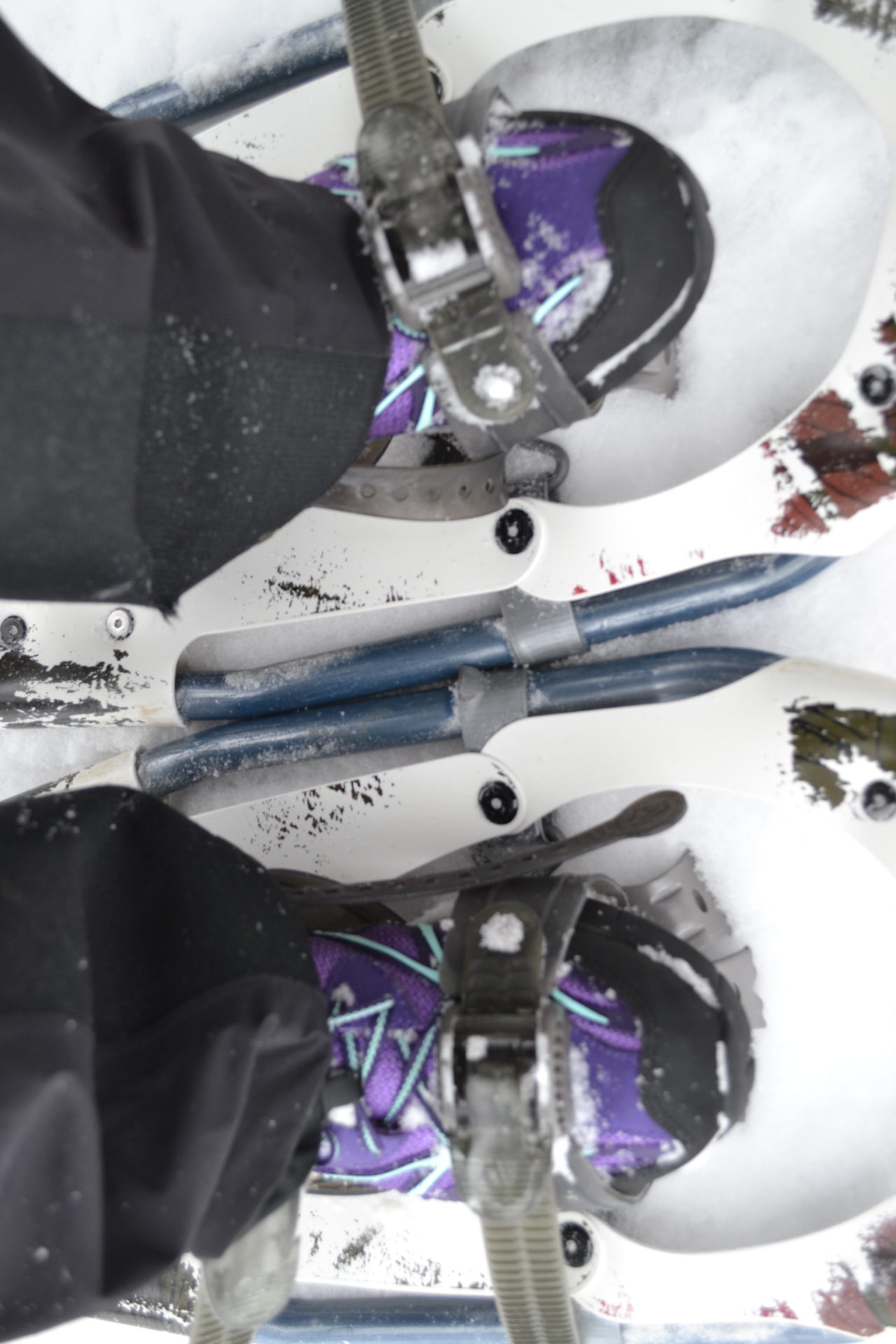
Hiking trails are great anytime of the year! In winter, bring along your snowshoes no matter which trail you decide to tackle. Whenever I found myself in Stephenville with a couple hours to spare, I usually head out to the Gravels Walking Trails to check out their condition. Hike #8 in Hikes of Western Newfoundland, this trail…
Snowshoe Adventure: East Point Trail
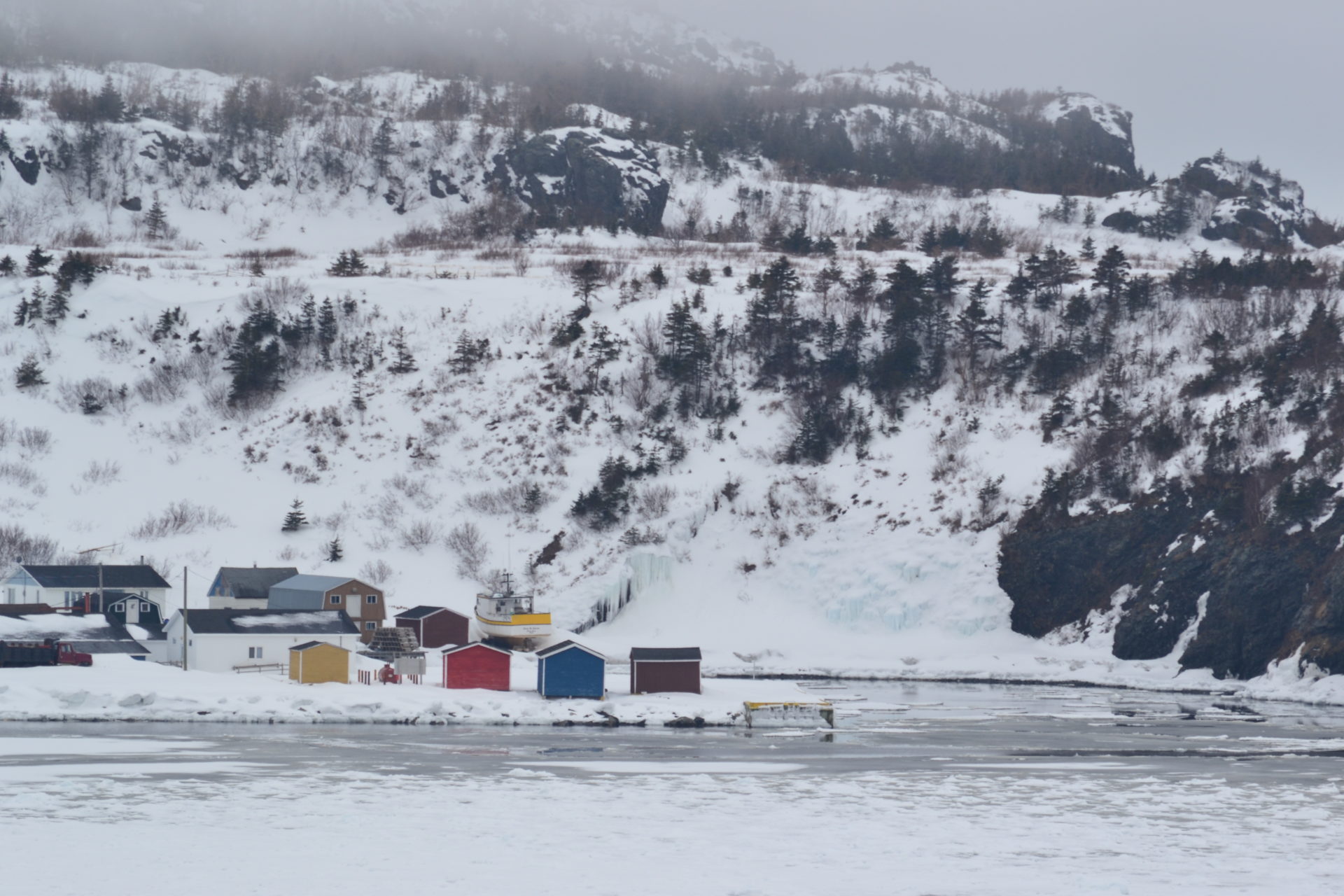
Last weekend, Alice and I headed up to Gros Morne National Park to do some end of season snowshoeing. I am slightly embarrassed to say that I have never hiked or snowshoed the East Point Trail in Trout River. Well, was I in for a treat! It was a lovely warm day with low wind…